
The latter months of 2025 were rough for the BBC’s reputation as an impartial news broker.
In November 2025, Director-General Tim Davie and News CEO Deborah Turness resigned after a leaked internal memo alleged that a 2024 Panorama episode misleadingly edited a Donald Trump speech about 6 January to make it appear that the controversial US President was directly encouraging the Capitol riots.
The following month, Ofcom ruled that the documentary Gaza: How to Survive a Warzone breached the Broadcasting Code by failing to disclose that its narrator was the son of a Hamas official, sharply contradicting the BBC's own review of the situation.
While these two examples are fairly stark, I don’t always find accusations of BBC bias convincing. Indeed, when both sides of the political aisle routinely complain about BBC partisanship, it might be a sign that they are doing a fair job. Yet, when it comes to nicotine, we can objectively say that the Beeb are distorting public opinion on novel smoking-alternative products.
In May last year, we published an article that looked at all the BBC articles on the subject of nicotine and found a clear prejudice, with a crazy 94% of articles being negative about vaping and pouches.
But how did the next seven months go? Did the BBC try to bring a little balance to the debate?
Let’s take a look.
BBC nicotine bias?
Up until May last year, BBC articles about nicotine, vapes, and pouches were alarmingly biased. A full 94% of 35 articles were negative, with not even one article that could be characterised as positive.
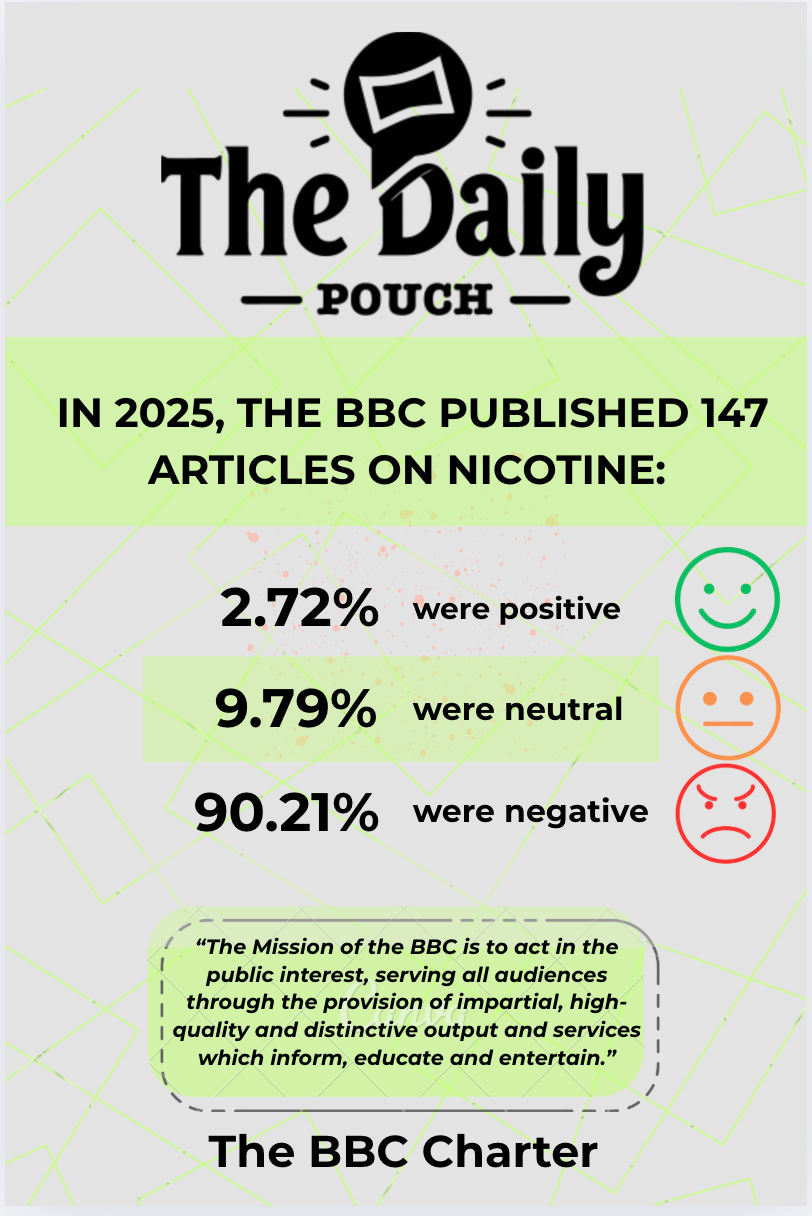
By the end of 2025, the BBC had published 147 articles on the subject. Four of these pieces could be roughly described as positive, with 14 fairly neutral. The remaining 129 were negative. While these numbers are shocking, they did constitute a slight improvement, because negative coverage dropped from 94% to 90%.
As highlighted in our previous article, this sort of jaundiced coverage represents a total failure to adhere to the standards set out in the BBC charter.

Why the gap?
The BBC likes to present itself as above the fray. The smugness of BBC Verify or disinformation expert Marianna Spring is off the charts, especially when they are leaning into some wacky right-wing conspiracy. But matters closer to home seem to slip past their attention.
One has to wonder whether any domain of human interest receives less balanced treatment or story selection by the BBC. Their coverage is often driven by public health advocates calling for stricter regulations; it rarely elevates the voices of those who have transformed their health by quitting smoking.
I don’t even think it’s editorial policy to diminish the achievements and potential of harm-reduction products. Sometimes these things just emerge due to a combination of poor research, prioritisation of establishment opinion, and the simple fact that negativity gets more engagement.
Still, the latter half of 2025 did see a slight improvement, with a few articles on stop smoking schemes given a positive spin. The thing is, we’re not even asking for favourable treatment for vapes and pouches, just impartial treatment.
While the BBC gets a lot of criticism, I don’t agree with people who want to defund or gut the organisation. It shouldn’t take Ofcom rulings for the BBC to acknowledge their failure to meet its own impartiality rules when it comes to harm-reduction tools. A little self-awareness goes a long way.